REVIEW · AUDIO TOURS
Downtown Honolulu Self Guided Walking Audio Tour
Book on Viator →Operated by History with Action · Bookable on Viator
Honolulu has a way of packing big history into short blocks. This Downtown Honolulu self-guided walking audio tour strings together palace legends, state politics, and Pearl Harbor remembrance into an easy 1–2 hour walk with 23+ location-triggered audio stories.
I like the way the stories are timed to what you’re standing in front of. I also like the practical setup: offline maps and hands-free playback mean you spend more time looking up at landmarks and less time fiddling with your phone.
One thing to consider: the experience depends on downloading the app and starting at the correct spot. If you’re not into tech at all, that first setup step can feel like a hurdle.
In This Review
- Quick take: what makes this walk worth your time
- Price and Lifetime Access: $9.99 That You Can Actually Use Again
- Getting Started at Aloha Tower Marketplace Without Losing Your Way
- How the Route Is Built: 1.6 Miles, 10-Minute Stops, 23+ Stories
- Stop-by-stop: what you’ll see and why it matters
- King Kamehameha Statue: Where power starts
- Kawaiahaʻo Church: The national church idea
- The missionary-period museum: A shift in the story
- Ali‘iolani Hale: From palace to government offices
- Honolulu Hale (City Hall): World tour returns and political plotting
- Patsy Takemoto Mink Statue and Memorial: Hawaii history past the monarchy era
- Sky Gate by Isamu Noguchi: Art that plays with perception
- Hawaii State Capitol: Government seats and historical context
- Eternal Flame Memorial: Pearl Harbor remembrance
- Washington Place: Queen Lili‘uokalani’s home base
- Iolani Barracks: The Royal Guard before the coup
- Iolani Palace: The only royal palace in the United States
- Queen Lili‘uokalani Statue: Love for her people as the final note
- Practical tips for doing this walk in real Honolulu weather
- What’s included, what’s not, and how to plan your day
- Who should book this Downtown Honolulu audio walk
- Should you book it? My decision guide
- FAQ
- How long is the Downtown Honolulu self-guided walking audio tour?
- How much does the tour cost?
- Where does the tour start and where does it end?
- Is this tour guided by a person?
- Do I need internet during the walk?
- What do I need to access the audio?
- Does the tour include lifetime access?
- Can I get a full refund if I cancel?
- What language is the tour in?
Quick take: what makes this walk worth your time

- Location-based audio that starts automatically as you reach each stop, so you can keep moving.
- Offline support after download, plus offline maps, for when signal gets spotty downtown.
- A tight route (about 1.6 miles) that still covers a lot of “core” Honolulu landmarks.
- Stop-by-stop context, from Hawaiian kings to government buildings to memorial sites.
- Free admission listed at most stops, so you’re not paying extra to see what the audio points out.
- Lifetime access with no expiry, so you can reuse it on future Honolulu visits.
Price and Lifetime Access: $9.99 That You Can Actually Use Again
At $9.99 per person for a 1–2 hour walking tour, the price feels fair for what you get: a structured route, audio storytelling, and guidance that follows your GPS location. In a city where many tours cost way more and still only last a couple of hours, this is the “pay once, use anytime” approach.
The standout value is new lifetime access with no expiry. That means you’re not paying just to do it once today. If you come back to Oahu next year (or you just want a second pass with a calmer pace), you can run it again without repurchasing.
The route also has a lot of “you-can-do-it-anytime” flexibility. You can start when you want within the day’s hours, pause for snacks and photos, and keep going at your pace.
You can also read our reviews of more walking tours in Oahu



Getting Started at Aloha Tower Marketplace Without Losing Your Way
This is a self-guided walk. No one meets you at the start, so your job is simple: go to the starting point and let the audio begin as you reach the first landmark.
Start location:
- Aloha Tower Marketplace, 1 Aloha Tower Dr, Honolulu, HI 96813
End location:
- Queen Lili‘uokalani Statue, 21024001 Honolulu, HI 96813
Before you go, you’ll get instructions by email and text with a password. You’ll also need to download the separate Action Tour Guide App. The key practical point is that you must download while you have strong Wi‑Fi/cellular, then it works offline after that.
On-site, you open the app, pick the correct version if there are multiple, and start the tour. From there, the stories play automatically as you walk—no “press play every minute” routine.
My advice: if you’re the type who forgets to charge your phone (or you wait until you’re already walking to set things up), do a quick tech check before you leave the start area. Honolulu heat can punish delays.
How the Route Is Built: 1.6 Miles, 10-Minute Stops, 23+ Stories

The whole tour covers over 1.6 miles and is designed for about 1–2 hours. Many stops are written as roughly 10 minutes each, which is helpful because you can predict how long the walk will take you even if you pause for photos.
Because the audio is triggered by location, it works best when you walk at a steady pace and stay close to the suggested path. If you wander far off, you might wait a bit for the next story cue.
Also note: most stops list admission as Free, but that doesn’t replace good common sense. Hours and access can still change depending on the day, so keep your expectations flexible if you hit a closed door.
Stop-by-stop: what you’ll see and why it matters
King Kamehameha Statue: Where power starts
You begin with the King Kamehameha Statue, a dramatic opening that frames the Hawaiian Islands as a place where chiefs fought for control in the 1700s. The audio describes Kamehameha as an intimidating warrior, remembered through vivid language from his contemporaries.
Why this works: starting here gives you the big backdrop you need for everything that follows. After this, the later stories about government, monarchy, and political change feel less random and more connected.
Quick watch-out: the opening story sets a tone. If you’re visiting during a very hot part of the day, consider starting early so your motivation lasts past the first mile.
You can also read our reviews of more guided tours in Oahu






Kawaiahaʻo Church: The national church idea
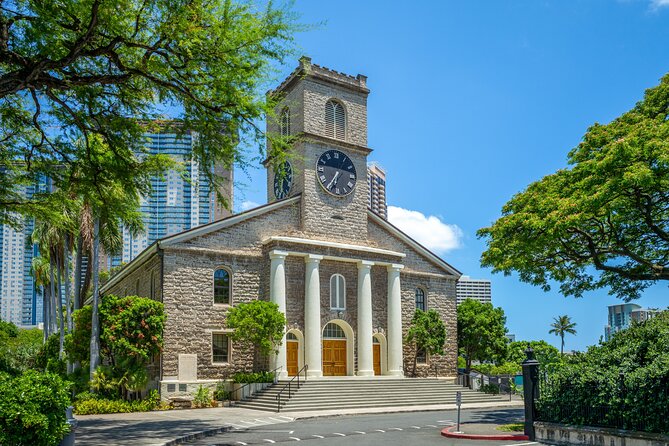
Next up is Kawaiahaʻo Church. The audio notes that it once functioned as the national church of the Hawaiian Kingdom.
This stop is less about flashy views and more about understanding how spiritual institutions and national identity intertwined. If you pay attention here, you’ll catch why later chapters about culture and power feel so intertwined.
The missionary-period museum: A shift in the story
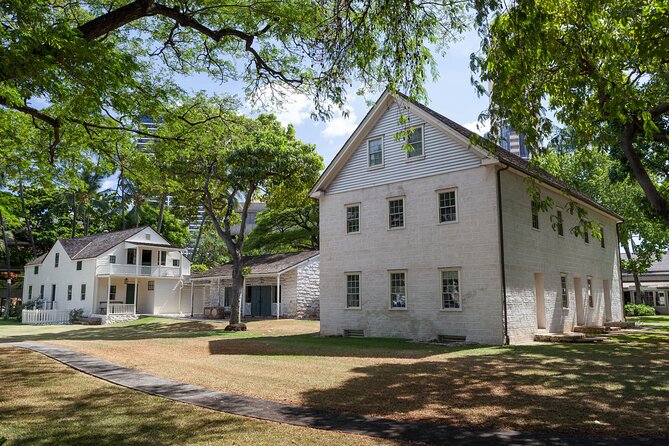
The route includes a stop at a museum showcasing items from Hawaii’s missionary period. The placement matters: it’s right after the church stop, so you’re moving from religious role to the artifacts and era that came with broader change.
What you’ll likely appreciate: a museum stop gives your brain a break. After walking and hearing political stories, you get a more contemplative pace.
Drawback to consider: museums can add waiting time if there are lines or if you linger too long. This tour’s rhythm depends on you keeping moving, even if you stop to look closely.
Ali‘iolani Hale: From palace to government offices
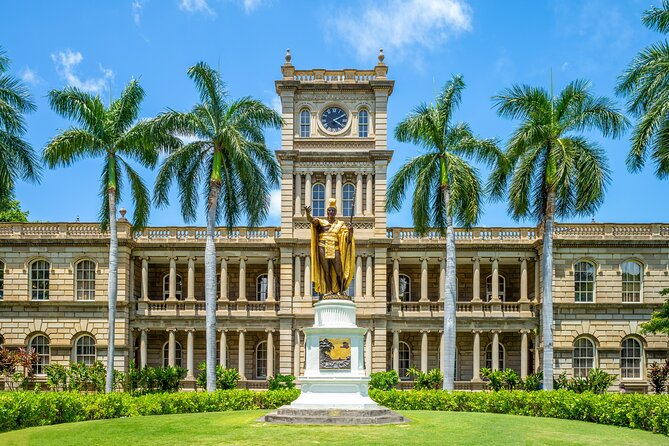
At Ali‘iolani Hale, the audio explains that Kamehameha V built it as a palace for Hawaiian monarchs. Later, King Kalākaua converted it into government offices.
This is one of those locations where you can see the theme of the day: spaces for leadership shift roles over time. If you like cause-and-effect history, you’ll like how the story points you toward the larger political transition.
Honolulu Hale (City Hall): World tour returns and political plotting
Your next landmark is Honolulu Hale (City Hall). The audio covers King Kalākaua returning from his world tour at the end of 1881, with celebrations across Honolulu, including a “Welcome Home” banner across Honolulu Harbor. Then the story pivots to the politics: others plotted his downfall, including the Reform Party, described as mostly American and enabled by the political shift after the 1875 Reciprocity Treaty.
This is a good example of what makes audio-guided walking tours practical: you don’t just read history in a book. You hear it attached to the specific places it relates to.
Patsy Takemoto Mink Statue and Memorial: Hawaii history past the monarchy era
The tour then moves into more modern Hawaiian history with the Patsy Takemoto Mink Statue and Memorial. The audio highlights that Mink was a third-generation Japanese-American who grew up in Hawaii.
If you tend to expect everything in Honolulu to focus only on royal palaces, this is a helpful correction. It broadens the story beyond the late 1800s and early 1900s.
Sky Gate by Isamu Noguchi: Art that plays with perception
At Sky Gate by Isamu Noguchi, the audio gives you a simple prompt: what do you see when you look at it? The story nudges your interpretation toward spider-web ideas, sky imagery, or even a three-legged animal shape.
I like this kind of stop because it breaks the “facts only” pattern. You’re asked to notice form and meaning, and then you connect it back to Noguchi’s description of Sky Gate as an evocation to the skies of Hawaii.
Hawaii State Capitol: Government seats and historical context
Next is the Hawaii State Capitol. The audio points out that before its construction, Hawaiians used the ‘Iolani Palace as their seat of government—so the Capitol feels like the successor chapter.
This stop is good for people who like political systems. It’s also a nice bridge stop: the audio sets you up to see the ‘Iolani Palace soon.
Eternal Flame Memorial: Pearl Harbor remembrance
At the Eternal Flame Memorial, the audio focuses on the people who died in the December 7, 1941 attack on Pearl Harbor and the “date which will live in infamy” line.
Even if you’ve heard Pearl Harbor history before, this stop can reset your sense of scale. A memorial is a different kind of education than a museum, and the audio helps you connect the place to the human cost.
Tip: pause for a moment here. Don’t rush this one.
Washington Place: Queen Lili‘uokalani’s home base
The route then heads to Washington Place, the former home of Queen Lili‘uokalani. The story frames it as her residence, set back from the road in a quieter way than you might expect.
This is another stop where the context matters: the audio is building toward the later ‘Iolani stories, so you start to see how royal life continued through a personal home environment after public power declined.
Iolani Barracks: The Royal Guard before the coup
The tour pauses before the Iolani Barracks. The audio explains that before Dole and the Annexation Club completed their coup against Queen Lili‘uokalani, the Barracks housed the Queen’s Royal Guard.
I like how this turns a simple building into a power timeline. The audio doesn’t treat annexation as a distant event; it makes it feel like something that had immediate local consequences.
Iolani Palace: The only royal palace in the United States
Then comes the big finish: Iolani Palace, dating back to 1879. The audio emphasizes that it’s the only royal palace in the United States.
Even if you’ve seen photos online, hearing the story while standing there changes your sense of scale. This is the payoff stop, the one that pulls together the themes: monarchy, government, and the way history reshapes built spaces.
Queen Lili‘uokalani Statue: Love for her people as the final note
Finally, you reach the Queen Lili‘uokalani Statue, the tour end point. The audio describes how Lili‘uokalani retreated from public life over time, returned full-time residence at Washington Place, and remained Queen to Native Hawaiians who visited her often.
The audio includes her memoir sentiment about giving her last drop of blood for her people. It’s a strong emotional close for a walking route that began with conflict and power struggles.
Practical tips for doing this walk in real Honolulu weather
Honolulu can be warm and sticky, and the route isn’t designed as a “sit down indoors all day” plan. The audio may keep you entertained, but your body still has to do the walking part.
My suggestions:
- Start earlier in the day if you can. The afternoons can feel like a heat tax.
- Bring water. You’ll be less annoyed with the route if you’re not dehydrated.
- Use headphones so the location audio stays clear. The tour is built for hands-free listening, but the sound quality depends on your setup.
- Expect a lot of short landmark moments. This walk is a sequence, not one long “grand museum” day.
If you’re traveling as a couple, there’s a cost-saving trick built in: you can share one tour by splitting headphones.
What’s included, what’s not, and how to plan your day

Included:
- Audio storytelling and on-location playback
- Offline maps
- Hands-free guidance tied to your location
- An easy app workflow via Action’s Tour Guide App
- Lifetime access with no expiry
Not included:
- Attraction passes, entry tickets, or reservations
That last line matters for planning. Even though many stops list free admission, I’d still treat the day like this: you’re arriving and exploring with what’s available on-site that day. If an area needs an entry ticket you don’t have, you’ll need a backup plan.
Also, this is a private tour/activity, meaning it’s only your group. That’s a nice plus if you hate the stress of fitting into other people’s schedules.
Who should book this Downtown Honolulu audio walk
This tour is a strong fit if you:
- Want a structured walking route without paying for a live guide
- Like history that’s tied to specific buildings, statues, and memorials
- Prefer pace control: start when you want, pause when you need photos or shade
- Plan to revisit Honolulu later and want to keep access for future trips
It may not be ideal if you:
- Hate apps and prefer staff guiding every step
- You expect guaranteed “it will work instantly” tech
- You’re not comfortable downloading the app ahead of time and verifying the tour starts correctly
Should you book it? My decision guide
Book it if you want an inexpensive, well-paced way to see Downtown Honolulu’s landmark chain—from Kamehameha to Kawaiahaʻo Church, through Ali‘iolani Hale, and ending at Queen Lili‘uokalani’s statue near the palace grounds.
I’d only pause before booking if you know you’re the type to struggle with phone setup while standing outside in the heat. If that’s you, plan to spend 10–15 minutes at the start area getting the app running with strong signal before you begin walking.
If your goal is value and flexible pacing, this is an easy yes. For $9.99, you’re buying a route plus stories plus offline capability, and you get to keep it for life.
FAQ
How long is the Downtown Honolulu self-guided walking audio tour?
It’s listed as about 1 to 2 hours. The route is over 1.6 miles long, with many stops designed for around 10 minutes each.
How much does the tour cost?
The price is $9.99 per person.
Where does the tour start and where does it end?
It starts at Aloha Tower Marketplace, 1 Aloha Tower Dr, Honolulu, HI 96813. It ends at the Queen Lili‘uokalani Statue, 21024001 Honolulu, HI 96813.
Is this tour guided by a person?
No. It’s self-guided, and no one will meet you at the start. You start the audio in the app when you arrive onsite.
Do I need internet during the walk?
You should download the tour while you have strong Wi‑Fi/cellular. After that, it works offline, including offline maps.
What do I need to access the audio?
After booking, you’ll receive email and text instructions with a password. You’ll also download Action’s Tour Guide App, then enter the password in the app to start the tour.
Does the tour include lifetime access?
Yes. The access is listed as new and lifetime, with no expiry, and you can use it any time on any trip as many times as you want.
Can I get a full refund if I cancel?
Yes, free cancellation is available up to 24 hours in advance for a full refund.
What language is the tour in?
The tour is offered in English.