REVIEW · AUDIO TOURS
Honolulu’s Waikiki Self-Guided Walking Audio Tour
Book on Viator →Operated by History with Action · Bookable on Viator
Taft’s ring of steel starts your walk in Waikiki. You’ll follow a location-triggered audio route through famous beachfront spots, statues, and big-name hotels—then you can pause, skip ahead, or wander off for photos whenever you want. It’s a simple way to understand Waikiki’s past without feeling stuck in a group schedule.
Two things I really like: the hands-free, GPS-triggered stories (audio plays as you reach each point), and the lifetime access so you can reuse it on future trips instead of treating it like a one-and-done ticket. The route packs in more than 45 audio stories, so you get real context at a pace you control.
One consideration: the full walk is over 14 miles and typically takes about 2–3 hours, so it’s best for people who enjoy long, steady walking. Also, you must download the tour with strong Wi‑Fi/cellular first, or you could have audio trouble later.
In This Review
- Quick Hit Key Points Before You Go
- What You Get for $9.99 Walking Waikiki
- How to Listen Without Wi‑Fi: App Setup That Actually Matters
- Route Length Reality Check: 14+ Miles, 2–3 Hours, and Your Pace
- Stop-by-Stop: Taft to Duke, With Concrete Details That Feel Alive
- Taft’s Ring of Steel: When Concrete Meant Protection (Early Walk)
- Kawehewehe: One of Waikiki’s Ancient Healing Sites
- Bali Oceanfront: Lifesource Since Early Polynesian Settlement
- Princess Kaiulani Statue: Waikiki’s Last Heir to the Throne
- Duke Kahanamoku Lagoon: Surf Legend, Right in the Air
- Moana Surfrider, A Westin Resort & Spa: A Hotel With Real Power and Real Mystery
- The Surfing Fever Story: How Watching Duke Changed Everything
- Kuhio Beach Hula Show: Relaxing Beach Logic With Family-Friendly Water
- Waikiki Wall: Why Concrete Belongs Here
- Kalākaua Avenue: Olympic Medals, WWII Service, and Sheriff of Honolulu
- Makua and Kila: A Statue That Literally Says Aloha
- Waikiki Walkway: The Legacy You Can See in Motion
- Where This Tour Fits in Your Waikiki Day
- Who Should Book This Self-Guided Walk
- Value vs. a Traditional Walking Tour: What You Gain and Trade Off
- Final Practical Note: Safety and Conditions
- Should You Book the Honolulu Waikiki Self-Guided Walking Audio Tour?
- FAQ
- How long is the Waikiki self-guided walking audio tour?
- Is this tour really self-guided with no guide?
- Where does the tour start and where does it end?
- Does it work offline once I download it?
- Do I need Wi‑Fi to use it?
- What do I need to start touring?
- Is there any admission included for the stops?
- Is the tour refundable if my plans change?
Quick Hit Key Points Before You Go
- Lifetime access, no expiry means you can replay Waikiki any time you return.
- Offline maps and audio let you keep walking even without signal (after you download).
- 45+ audio stories cover healing sites, royalty, surfing history, and iconic buildings.
- Location-triggered playback keeps you from constantly tapping your phone.
- A true walking route runs about 14+ miles, so plan for a full afternoon stretch.
What You Get for $9.99 Walking Waikiki
For $9.99, you’re not buying another photo stop. You’re buying a guided explanation system you carry yourself. That matters in Waikiki, where it’s easy to treat the area like a beach-and-hotel backdrop. This tour slows you down long enough to notice the details: concrete, statues, and small named places that usually blur together.
The value comes from two places. First, it’s new, lifetime access with no expiry, so you can listen again on a future Oahu trip. Second, you get offline maps and an audio guide that plays automatically—so you’re not constantly checking your phone while you’re in the sun.
The stories cover a wide range: President Taft’s 1904 coastal defense plan, ancient healing sites, and the way Duke Kahanamoku’s surfing shaped world attention. It’s the kind of context that makes Waikiki feel less like a postcard and more like a living shoreline.
You can also read our reviews of more walking tours in Oahu



How to Listen Without Wi‑Fi: App Setup That Actually Matters

This is a self-guided tour, meaning no one meets you at the start. You go to the starting point, open the app onsite, and begin the first story. After that, audio cues move you from stop to stop.
Here’s the practical workflow:
- After booking, you’ll receive an email and text with setup instructions and a password (search audio tour).
- You must download the separate Action’s Tour Guide App while you have strong Wi‑Fi/cellular.
- Enter the password, then the tour works offline after the download.
That “download with good signal” part is the big make-or-break detail. If your phone only limps along on weak Wi‑Fi, you can end up with an app that installed but didn’t fully download the tour content. Once it’s downloaded, the audio uses your location to trigger stories, even when service disappears.
Also, plan to bring headphones/earbuds. If you’re traveling as a couple, there’s a cost-saving tip: you can share one tour by splitting headphones.
Route Length Reality Check: 14+ Miles, 2–3 Hours, and Your Pace
The tour says 1 to 2 hours on average. Then it also describes the full route as over 14 miles with 45+ audio stories, taking about 2–3 hours to complete. So treat 2–3 hours as your safer planning number, especially if you pause often for photos and beach breaks.
You can absolutely go at your own pace. The app supports start anytime, pause anywhere, and you can skip anything that doesn’t interest you. That’s the smart way to handle Waikiki, because you’ll naturally want to stop at certain beaches or landmarks.
Your walking anchors:
- Start: Brothers In Valor memorial, 2081 Kalākaua Ave, Honolulu, HI 96815
- End: Waikiki Walkway, Waikiki Wall, Honolulu, HI 96815
- Hours: 6:00 AM – 9:00 PM (daily, based on the listed operating window)
One more pacing note: the tour route expects you to stick close to the path and speed limit for the best location-triggered audio. If you sprint off the route and wander far, the story timing may lag.
Stop-by-Stop: Taft to Duke, With Concrete Details That Feel Alive
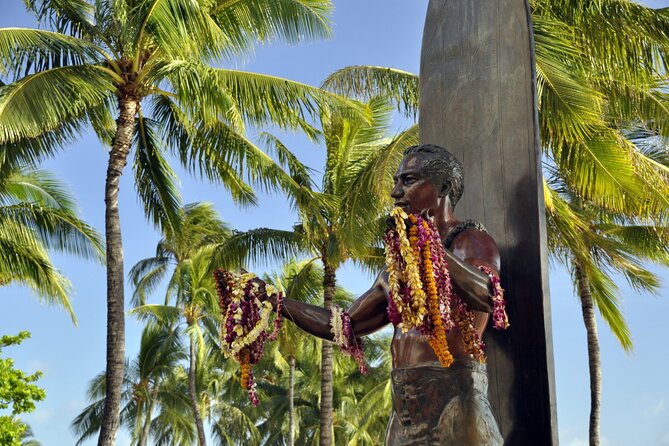
This tour is built like a stroll through layers of Waikiki. You’ll hear why certain spots matter—then you’ll stand in front of them and actually see them.
Taft’s Ring of Steel: When Concrete Meant Protection (Early Walk)
Your route begins with a chunk of concrete tied to President Taft’s demand in 1904. The audio frames it as a “Ring of Steel” plan built around Hawaii’s coast to protect against attacking battleships.
This start is a good choice because it resets your expectations. Waikiki isn’t only palm trees and ocean views. It’s also infrastructure, defense history, and the practical decisions that shaped the coastline. Even if you only catch a minute of that story at the right spot, it makes the walk feel intentional.
Why it’s worth your attention: it’s one of those details you’d miss if you only looked for big postcard landmarks.
You can also read our reviews of more guided tours in Oahu






Kawehewehe: One of Waikiki’s Ancient Healing Sites
Stop 1: Kawehewehe. The audio describes deeper blues and a strip of light blue with a sand-bottom ocean—then ties it to one of the four ancient healing sites in Waikiki.
Even if you aren’t a snorkeling expert, the description encourages you to look closely at the water. You’re not just staring at scenery; you’re learning how people once used this shoreline for healing.
Watch for: the spot is free to view, but you’ll still want to be mindful of how you stand while listening near the water.
Bali Oceanfront: Lifesource Since Early Polynesian Settlement
Stop 2: Bali Oceanfront. Here, the audio connects these waters to the lifeblood of Hawaiian life, starting with Polynesians settling between 400 and 1100 CE.
This is the tour’s pattern: it gives you a timescale, then you stand where the ocean is still doing what it always did. It turns “beach time” into “place understanding.”
Princess Kaiulani Statue: Waikiki’s Last Heir to the Throne
Stop 3 is the Princess Kaiulani Statue. Waikiki has lots of famous names, but the story focuses on Princess Kaiulani as Hawaii’s last heir to the throne, and why she remains beloved in this area.
This kind of stop helps you notice how Waikiki remembers people. Instead of treating statues as decoration, you learn the emotional reason they were placed here.
Duke Kahanamoku Lagoon: Surf Legend, Right in the Air
Stop 4: Duke Kahanamoku Lagoon. The audio frames a transition—Princess Kaiulani passes in 1899, and Duke Kahanamoku rises as another Hawaiian hero.
Then you get the surfing legend angle: the story begins in the shadows of palm trees, on the crest of a distant breaker. Even if you know the basics about Duke, this location cue makes you feel the visual logic—waves, palms, then the man.
Moana Surfrider, A Westin Resort & Spa: A Hotel With Real Power and Real Mystery
There’s an iconic hotel stop along the way: the place that debuted in 1927 and later hosted big-name celebrities like Marilyn Monroe and presidents like Franklin Roosevelt—and connects to Duke Kahanamoku.
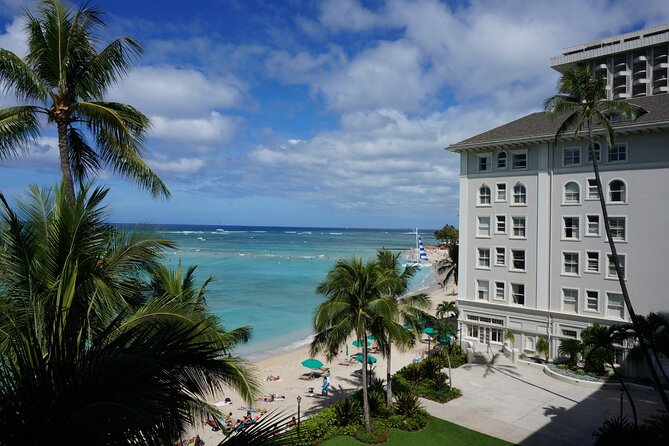
Stop 5 specifically highlights the Moana Surfrider, A Westin Resort & Spa, Waikiki Beach. The audio notes it was built in 1901 and featured the first electric-powered elevator in Hawaii, still in use. It also points to one of America’s unsolved mysteries: the murder of Jane Stanford.
This is where the tour becomes more than “Hawaiian history 101.” It shows how Waikiki’s famous buildings also hold stories of technology, power, and intrigue.
Potential drawback: if you’re not interested in hotel history or the Jane Stanford mystery, this stop may feel less rewarding than the beach and statue moments. You can still treat it as a quick listen and move on.
The Surfing Fever Story: How Watching Duke Changed Everything
Right after the Moana Surfrider segment, the audio shifts into the early 1900s context: most people hadn’t seen anyone surf, then Duke appears and demonstrates. The story describes a surfing fever that spread worldwide because people wanted a piece of what they just watched.
This is valuable because it explains the “why” behind Duke’s global fame, not just the fact that he was famous.
Kuhio Beach Hula Show: Relaxing Beach Logic With Family-Friendly Water
Stop 6 is Kuhio Beach Hula Show near one of the best beaches in town (as the audio describes it). It’s suggested as a place for snorkeling or bodyboarding. The tour also explains something practical and very Waikiki: both sides of the beach are enclosed by concrete walls that extend into the ocean, creating a calm wading area for families.
How to use this moment: you can listen for the reason the water calms down, then use the stop to decide if you want to dip in or just hang out.
Waikiki Wall: Why Concrete Belongs Here
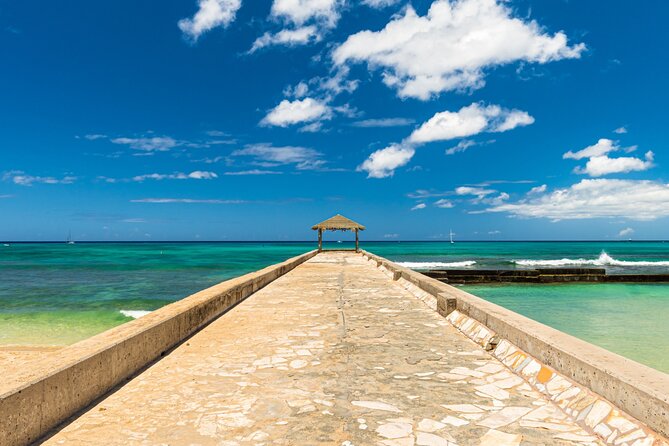
Stop 7: Waikiki Wall. At first glance, it can look out of place in a tropical paradise. But the audio explains that the wall has been here so long it’s become part of the scenery.
This stop teaches you how to look at Waikiki without ignoring the built structures. Sometimes the “ugly” things become the familiar things—especially when nature and concrete have lived side by side for decades.
Kalākaua Avenue: Olympic Medals, WWII Service, and Sheriff of Honolulu
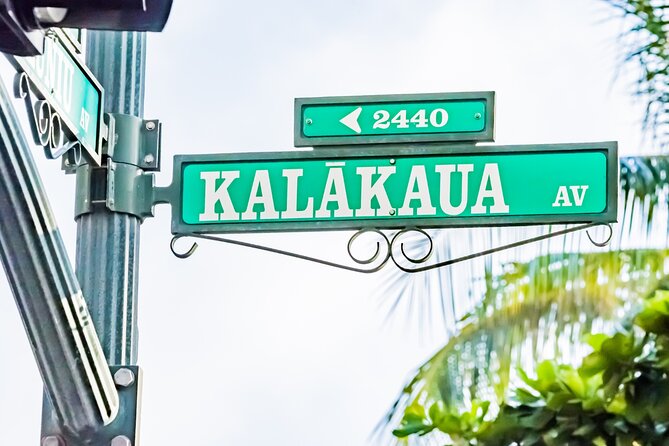
Stop 8: Kalākaua Avenue. The story follows Duke Kahanamoku after he retired from the Olympics in 1932, noting he earned three gold and two silver medals. Then it moves through WWII service and multiple terms as Sheriff of Honolulu.
The payoff here is understanding how Duke’s public role extends past sports. The audio ties location to a longer résumé.
Makua and Kila: A Statue That Literally Says Aloha
Stop 9: Makua and Kila Statue. The audio describes a young surfer and an unlikely friend: a Hawaiian monk seal. The story invites you to greet them with aloha because they’re always glad to see visitors.
This is one of those stops that works even if you’re not an art person. The combination of human + marine animal makes you look at the area with a softer lens.
Waikiki Walkway: The Legacy You Can See in Motion
Stop 10 ends at Waikiki Walkway, near Waikiki Wall. The audio describes the spirit of Duke and what he stood for: people surf and swim, they laugh and love. It adds that until Duke’s death in 1968, he hoped those things would continue.
This is a satisfying finish because it’s not only about the past. It’s about how the area functions now—people moving, water working, and the shoreline still serving as a social stage.
Where This Tour Fits in Your Waikiki Day
This audio tour works best when you treat it as your Waikiki backbone. Do a long walk, stop when you want, and let the stories shape where you pay attention.
A few practical ideas:
- If you’re beach-first, do it before you settle down. The early context (Taft, healing sites, royal history) makes the shoreline feel more meaningful.
- If you’re hotel-hopping, use the route to connect the famous stops without needing to constantly navigate.
- If you’re tired, you can pause and restart later since it’s designed for your own pace.
One small tip that helps: keep your phone ready and your headphones plugged in before you start each segment. The tour is location-triggered, so you don’t want to fumble mid-walk.
Who Should Book This Self-Guided Walk

I think this one fits you if you want:
- A way to understand Waikiki beyond beach photos
- A low-cost activity that can stretch into a few hours
- A self-paced walk where you can skip parts
It might be less ideal if you’re chasing a very short, very curated highlights tour. The full route is long, and it covers many stops. If you only want to hit a couple of icons, you could end up feeling like you’re dragging your way through extra listening.
On the other hand, because you can pause and skip, you can tailor it. Listen closely when a stop interests you, and treat other points as background ambiance.
Value vs. a Traditional Walking Tour: What You Gain and Trade Off
A live guide can answer your questions and adapt on the fly. This audio tour can’t do that. But it gives you something live tours often can’t: repeatable storytelling at a price that doesn’t sting your budget.
Here’s the trade:
- You gain control: start when you want, stop when you want, and revisit later with lifetime access.
- You trade spontaneity: if you want to ask follow-up questions on something specific like the Jane Stanford mystery, you’ll be working with what the audio already includes.
Still, for many visitors, that trade feels fair. The tour does a solid job of connecting Waikiki locations to stories that make the place make sense.
Final Practical Note: Safety and Conditions
The tour notes a tsunami warning possibility due to a massive earthquake in the Pacific Ocean and directs you to check tsunami.gov for up-to-date information. If any warnings are active during your dates, adjust your plans accordingly.
Also, start within the listed opening window (6:00 AM to 9:00 PM) so you’re not fighting darkness or limited access.
Should You Book the Honolulu Waikiki Self-Guided Walking Audio Tour?
If you’re the kind of traveler who likes learning while walking, this is a very good deal. $9.99 for an offline, location-triggered set of stories—plus lifetime access—is hard to beat in Waikiki, where history is everywhere but rarely explained in one place.
Book it if:
- You want a flexible plan you can reuse
- You’re okay with a longer walk (plan for up to 2–3 hours)
- You’ll bring headphones and download the tour with good signal
Skip it (or shorten it) if:
- You want only a quick, minimal stop set
- You hate long walking days
- You might struggle to download the app properly before you go
FAQ
How long is the Waikiki self-guided walking audio tour?
The tour is listed as about 1 to 2 hours on average, but it also describes a full route of over 14 miles that typically takes about 2–3 hours to complete.
Is this tour really self-guided with no guide?
Yes. No one meets you at the start. You go to the starting point and start the first story in the Action’s Tour Guide App. Audio plays automatically as you move.
Where does the tour start and where does it end?
It starts at Brothers In Valor memorial, 2081 Kalākaua Ave, Honolulu, HI 96815, and ends at Waikiki Walkway at Waikiki Wall, Honolulu, HI 96815.
Does it work offline once I download it?
Yes. It includes offline maps, and it’s designed to work without cellular or Wi‑Fi after you download the tour content.
Do I need Wi‑Fi to use it?
You must download the tour while you have strong Wi‑Fi or cellular connectivity. After that, it works offline.
What do I need to start touring?
After booking, you’ll receive an email and text with setup instructions and a password. You then download the Action’s Tour Guide App, enter the password, and launch the tour in the app at the correct starting point.
Is there any admission included for the stops?
No. Attraction passes, entry tickets, or reservations are not included. The tour includes storytelling and route access, and the listed stops show free admission.
Is the tour refundable if my plans change?
There’s free cancellation. You can cancel up to 24 hours in advance for a full refund. If you cancel less than 24 hours before the start time, the amount paid is not refunded.