REVIEW · SURFING LESSONS
Private Group Surf Lesson for 4 by Waikiki Beachboys at the Royal
Book on Viator →Operated by Waikiki Beach Services · Bookable on Viator
First-time surf in Waikiki, with real coaching. This 1-hour private group lesson starts at the Royal Hawaiian area and teaches you how to ride at Waikiki’s iconic shoreline. You’ll get surfing theory and practical mechanics, plus the history that makes this beach more than just a fun swim.
I love how much personal attention you get with a small group of 4 to 5 people. I also like that your surfboard is included, so you’re not scrambling for rentals before you even hit the water.
One consideration: you must be able to swim, and some beginners may feel the lesson moves fast once you’re in the ocean. If you want extra patience on land, speak up early so the coach can adjust.
In This Review
- Key Highlights at a Glance
- Waikiki at the Royal: where your surf lesson starts
- What you learn in the first hour: paddle, stand, and balance
- Private group size (4–5 people): how attention really works
- Gear included (and what you still need to bring)
- Who this lesson suits (and who should reconsider)
- Price and value: what $100.76 buys you in real terms
- Photos, video, and keeping your surf day from getting messy
- Should you book this Waikiki Beachboys Royal lesson?
Key Highlights at a Glance
- Waikiki location tied to the roots of surfing, not some generic beach lesson
- Small private group (4–5 people) for more coaching per person
- 1-hour lesson focused on paddling, standing, and balance basics
- Surf theory plus mechanics plus history so you understand what you’re doing
- Board included, and you’re not paying extra for basic gear
- Good for people who can swim and handle a moderate physical effort
Waikiki at the Royal: where your surf lesson starts
Your session begins at Waikiki Beach Services at the Royal Hawaiian, 2259 Kalākaua Ave in Honolulu. This is a very practical setup for Waikiki because you’re close to the action, and you’re not bouncing around the island looking for a “special” beach location.
It also matters that this is specifically aimed at Waikiki—often called the birthplace of surfing. In real terms, that usually means you get instruction in the same kind of water context people associate with Hawaiian surf culture: sandy shorelines, frequent training conditions, and a beach scene that’s built around surfing.
The lesson ends back at the same meeting point. That gives you a clean, easy loop for the rest of your day—grab food afterward, check out the Royal Hawaiian area, or keep exploring without needing a second pickup plan.
You can also read our reviews of more private tours in Oahu

What you learn in the first hour: paddle, stand, and balance
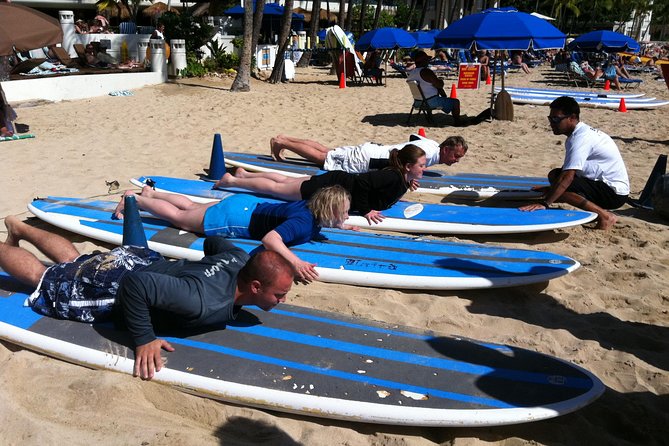
This lesson is built around three core skills, because those are the steps that turn flailing into actual progress:
First is paddling—not just “go harder,” but learning how to position yourself and move efficiently so you can catch waves when they come. Even if you’re athletic, paddling is usually where first-timers waste their energy, so the coaching focus here is a big deal for your success rate.
Second is getting into the stand-up motion. Most people think standing is the hard part, but the real challenge is doing it at the right moment and with your weight where it needs to be. The instruction aims to make that sequence feel repeatable rather than random.
Third is balance. You’ll work on staying stable as the board starts moving. That’s why balance training matters early: it helps you avoid the common cycle of wobble, panic, fall, repeat.
You’ll also hear surf theory, mechanics, and history. That part isn’t just trivia. When someone explains what the wave is doing and why your body position matters, the “how” clicks faster. In a good surf lesson, you stop guessing and start making small corrections instead.
All lessons are exclusive to your group and run about 1 hour. That time constraint is worth noting: you will move from basics to hands-on attempts fairly quickly, which is great if you want momentum, but it does mean you should show up ready to work.
Private group size (4–5 people): how attention really works
This is marketed as a private group experience, but the key isn’t the word private—it’s the group size. You’ll be in a tight band: minimum 4 participants and maximum 5. In practical terms, that’s enough people for shared energy, but small enough that the guide can watch body positions and make adjustments without feeling like a bus monitor.
That matters most in surf lessons because coaching isn’t just instructions—it’s real-time feedback. If you’re out on the water and your stance is off, you need quick corrections. Smaller groups typically mean fewer people to watch and more chances for the coach to spot what needs fixing.
The reviews linked to this experience point to a clear pattern: when the instructor is patient and hands-on, people feel genuinely guided. When an instructor is less invested in coaching detail—more focused on getting you to paddle than teaching—beginners can struggle. The difference isn’t the setting; it’s the coaching style.
So here’s my practical advice: if you’re a total beginner, make sure you communicate that up front. Ask for clear cues on what to do next when you’re in the water. You’re paying for instruction—don’t assume the guide will slow down unless you request it.
Gear included (and what you still need to bring)
Good value comes from cutting friction. Here, the surfboard is included. That’s one less rental decision and one less cost before you even start learning.
But a few items are on you:
- Bring your own towel
- Bring sunscreen
- Bring a rash guard
That last one can feel annoying, but it’s also practical. Rash guards help reduce friction that can make beginner falls sting more than they need to.
Also, towels and sunscreen being your responsibility affects comfort and timing. If you forget, you’ll either have to buy something right in Waikiki (fine, but adds cost) or you’ll have a less comfortable stretch after you get out of the water.
Two more notes that affect your day:
- You’ll need to sign a waiver.
- You must have the stamina for basic ocean activity, and you must be able to swim.
If you’re planning your surf day, treat it like a workout: apply sunscreen before you go, bring your towel, and wear your rash guard so you can focus on learning.
Who this lesson suits (and who should reconsider)
This lesson is designed for participants over 13 years old and it’s not positioned as a tiny-child activity. Age matters because balance, strength, and learning pace tend to be different for younger kids.
For under 12, the data you have suggests you’d need a one-on-one private individual lesson option instead. If your group includes younger kids, it’s worth planning that separately so nobody is stuck in the wrong format.
You also need a moderate physical fitness level. That doesn’t mean you need to be a gym machine, but you should be able to:
- paddle for short bursts,
- get up and down off the board safely,
- handle repeated falls without panicking.
Most importantly: you must be able to swim. This is an ocean sport lesson, not pool training. If you’re hesitant in open water, that hesitation can spill into everything—your paddling, your confidence, and your willingness to try again.
If you’re a first-timer who wants to learn in Waikiki with a small group and a strong focus on fundamentals, this fits nicely. If you need ultra-gentle coaching and lots of on-land practice before ocean time, you may want to be selective with your expectations and ask for what you need immediately.
You can also read our reviews of more tours and experiences in Oahu

Price and value: what $100.76 buys you in real terms
The price is listed at $100.76 per person for an approximately 1-hour session. It includes all taxes, fees, and handling charges, which is refreshing because surf lessons in tourist areas sometimes surprise you at checkout.
What’s included is also important:
- Professional guide
- Surfboard
- Taxes and included charges
What’s not included:
- souvenir photos and video (available to purchase),
- transportation to/from the attraction,
- towels and sunscreen,
- and a $1 Ocean Stewardship fee effective 01/01/2024.
So the value question is really about how likely you are to get good coaching in that hour. The lesson format is set up to help: small private group, fundamentals focus, and hands-on coaching.
At the same time, because this is a small-group private experience with 4 to 5 people, the coaching quality can depend on the instructor assigned that day. The good news is that the overall rating sits around 4.6 out of 5, and many comments emphasize patient instruction and taking the time to help people get the hang of it.
If you want the best value, treat this as learning time. Show up rested, swim confidently, and take correction the first time you hear it. That’s how you turn a one-hour session into real progress instead of just a fun splash and a few standing attempts.
Photos, video, and keeping your surf day from getting messy
Photos and video aren’t included, but they’re available to purchase. That’s common for surf lessons, and it’s also something you can plan for. If you love having a visual record, budget for it. If you’re more minimal, you can skip it and focus on the practical part: getting your body to work with the board.
Transportation is not included either. Waikiki is walkable in parts and there are plenty of taxis and rideshare options, but you should still plan your route to 2259 Kalākaua Ave.
Finally, because the lesson ends right back at the meeting point, the easiest plan is to pair it with something close by: a meal, a stroll, or a relaxed afternoon after you’re done. That makes the day feel less like logistics and more like vacation.
Should you book this Waikiki Beachboys Royal lesson?
I’d book this if you:
- want to learn to surf at Waikiki, in a small group with 4–5 people,
- can swim and you’re comfortable with a moderate workout effort,
- want a lesson that covers fundamentals (paddling, standing, balance) plus surf theory and history,
- like the idea of having the board provided.
I’d think twice if:
- you’re not confident in open water,
- you’re looking for a super slow, on-land-heavy intro with lots of individualized reassurance,
- or you’re hoping towels and sunscreen are included.
If you do book, bring your rash guard, towel, and sunscreen. Arrive ready to ask questions and to practice what the guide tells you. In surf, that combination is often the difference between awkward falls and that first clean, controlled ride.