REVIEW · HISTORICAL TOURS
Through A Glass Darkly The Strange and Tragic History Of Honolulu
Book on Viator →Bookable on Viator
Honolulu’s politics hide in plain sight. This 1.5-hour walk pulls together King Kamehameha’s conquest, the monarchy’s tragic overthrow at Iolani Palace, and the missionary-era power shifts across 10 stops. I especially love the storytelling flow and the chance to see royal, legal, and religious landmarks close together. One watch-out: entry to Iolani Palace and Capitol Modern is not included in the $39 price.
The route keeps things human. You’re not just staring at stone and bronze; you’re learning why these places were built, used, and reshaped over time. It’s run in a small group (up to 20), which helps the explanations feel specific instead of rushed.
You’ll also notice a slightly spooky streak. The tour leans into strange and tragic moments, including ghostly lore tied to the places you pass. If you want your history with a side of chills, this is your kind of walk.
In This Review
- Key things to know before you go
- A 90-minute story walk through Honolulu’s biggest turning points
- Stop 1: King Kamehameha Statue, where conquest becomes personal
- Stop 2: Iolani Palace, the monarchy’s end in a building you can still feel
- Stop 3: Kawaiaha’o Church, stone and mission power in one place
- Stop 4: Hawaiian Mission Houses Historic Site and Archives, where the work is framed as good
- Stop 5: Honolulu Hale, pretty Italianate Spanish Revival with a darker edge
- Stop 6: Hawaii State Capitol, aloha spirit plus the story of a queen
- Stop 7: Washington Place, Liliuokalani’s home and her return
- Stop 8: Cathedral of St. Andrew, England-cut sandstone and a tragic tale
- Stop 9: Capitol Modern (Hawai’i State Art Museum), from the Royal Hawaiian Hotel to today
- Stop 10: Ali’iolani Hale, the Judiciary Building and the Massie Affair
- Price and logistics: what $39 buys you in real terms
- Pace, comfort, and the slightly spooky tone
- Who this tour fits best
- Should you book this Honolulu history tour?
- FAQ
- FAQ
- How long is the Through A Glass Darkly Honolulu tour?
- Where does the tour start and end?
- How much does it cost?
- Is the tour offered in English?
- Is a mobile ticket used?
- Do I need to pay admission fees for the stops?
- Can I cancel for free?
Key things to know before you go
- Tight 10-stop route in about 90 minutes that covers monarchy, missionaries, and the courts
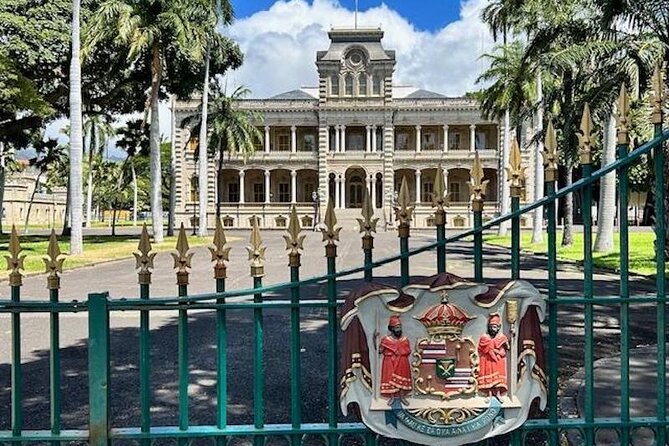
- Iolani Palace and Capitol Modern cost extra (most other stops are free)
- A small group size (max 20) that keeps the pace thoughtful
- Missionary sites with a pointed backstory including Kawaiaha’o Church and Hawaiian Mission Houses
- Royal Hawaiian Hotel origins at Capitol Modern plus the Pink Palace connection
- Strange-and-tragic storytelling with some ghostly lore woven in
A 90-minute story walk through Honolulu’s biggest turning points
This tour works because it keeps you moving while still explaining what you’re looking at. You start at the King Kamehameha I Statue, then step through a chain of sites tied to conquest, rule, resistance, and legal aftermath. It’s a smart way to get a whole framework without dedicating an entire day to museums.
At $39 per person, the value comes from the mix of free stops and the fact that the tour gives you the context you’d otherwise have to hunt down. Most of the walk is admission-free, so your main additional costs are the two interior stops listed as not included. That makes it easier to budget if you want to go inside the palaces or museum areas.
The tour is also practical. You’ll meet at 447 S King St and return to the same area. It runs in English, uses a mobile ticket, and is near public transportation. If you need help with stairs or inclines, assistance is available, and service animals are allowed.
You can also read our reviews of more historical tours in Oahu



Stop 1: King Kamehameha Statue, where conquest becomes personal
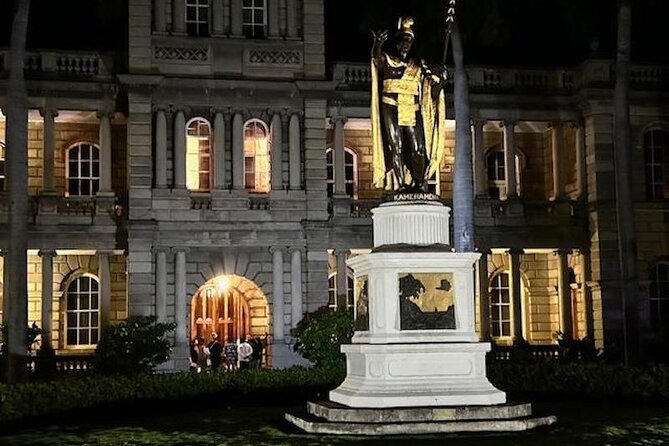
You kick off at the King Kamehameha Statue, and that matters. Starting with a central figure sets the tone: this isn’t a beach-only Honolulu. It’s a place where power changes hands, and the buildings and laws you see later make more sense once you understand how Oahu was conquered.
The story here is described as amazing and horrifying, which tells you the guide won’t treat history like a fairy tale. Expect to leave this first stop with clearer mental maps—who held authority, how it was gained, and why later events aren’t random.
Even if you only spend a few minutes at a statue, the guide’s framing helps you connect the rest of the route. When you reach later royal and legal sites, you’ll understand why those moments were so contested.
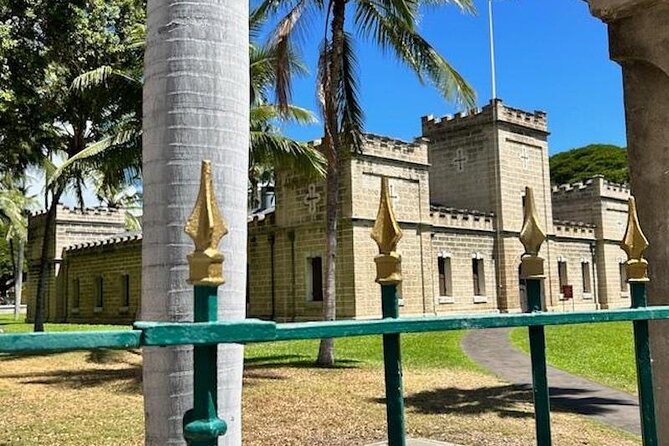
Stop 2: Iolani Palace, the monarchy’s end in a building you can still feel
Next is Iolani Palace, with time for a focused look (about 10 minutes). The basic hook is simple: imagine a royal palace in the United States, with kings and queens and thrones—and then learn how that story ends with a tragic overthrow of the monarchy.
This stop is also one of the biggest “decide your budget” moments. Admission is not included, so if you plan to go in, you should expect to pay separately. The upside is that the palace is the kind of place where having a guide’s explanation changes your experience fast.
One more tip: because this is a short stop, don’t get stuck trying to see everything at once. Instead, anchor on what the guide emphasizes—how the palace links to sovereignty and what the overthrow meant on the ground.
Stop 3: Kawaiaha’o Church, stone and mission power in one place

From the palace, you shift to Kawaiaha’o Church, where the tour focuses on design and intent. This “stone church” was designed by missionary Hiram Bingham, and the backstory is described as anything but simple for Native Hawaiians.
Even with only about 10 minutes, this stop can land hard because it connects architecture to cultural pressure. The building isn’t presented as neutral. You learn to read it as a symbol of how influence worked—religiously, politically, and socially.
If you like history that explains cause and effect, this is a strong moment. It turns a church visit into something more like a lesson on power.
Stop 4: Hawaiian Mission Houses Historic Site and Archives, where the work is framed as good
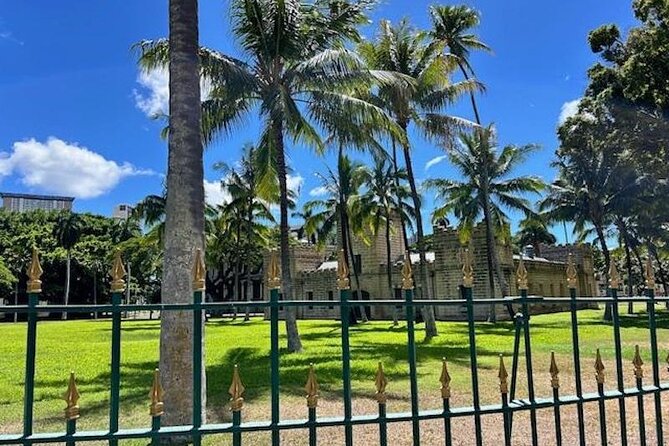
Then you step to the Hawaiian Mission Houses Historic Site and Archives. The tour summary points to a sharp idea: the missionaries came to do good, and they did very well—as Hawaiians say. That phrasing sets up a complicated evaluation, not a one-note story.
This is one of the stops that feels like it rewards curiosity. The guide’s explanations can help you notice what’s preserved, what’s emphasized, and what those materials were meant to communicate.
Because it’s about a short stop (around 5 minutes), you’ll want to keep your eyes open and let the guide’s framing do the heavy lifting. You’re not trying to finish a full archive visit; you’re getting oriented.






Stop 5: Honolulu Hale, pretty Italianate Spanish Revival with a darker edge
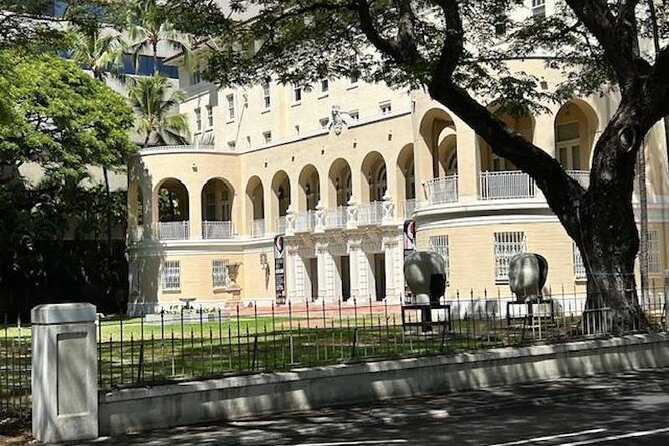
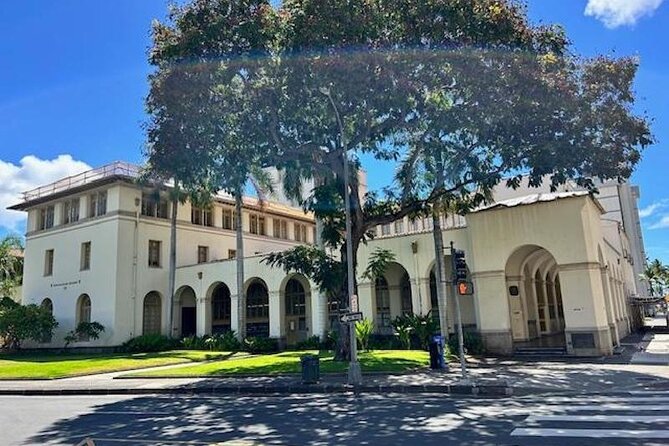
Honolulu Hale (City Hall) is next, and it’s described as lovely on the outside, with an unlovely past. That contrast is the point. The building style—Italianate Spanish Colonial Revival—is the visual hook, but the guide is there to explain what the site represents beyond looks.
This is a good stop if you like your sightseeing with a critical lens. City halls can look like paperwork and bureaucracy, yet they also reflect who has authority and how decisions get made.
Expect a quick hit of context. It’s short, but it helps you keep thinking beyond royal stories into civic power.
Stop 6: Hawaii State Capitol, aloha spirit plus the story of a queen
At the Hawaii State Capitol, you get an elegant expression of the aloha spirit, plus a statue tied to a queen who embodied that idea. It’s about symbolism: how values are turned into monuments, and how those monuments shape public memory.
With only about 5 minutes here, the best approach is to listen closely and focus on the statue and what the guide connects it to. That quick conversation often pays off when you look at other landmarks later—your brain starts grouping them by theme instead of treating them as unrelated photo ops.
Stop 7: Washington Place, Liliuokalani’s home and her return
Next comes Washington Place, connected to Queen Liliuokalani. The tour highlights two emotional angles: her unhappy marriage and her return after the overthrow of the monarchy.
This stop tends to hit because it’s personal. When you hear how the palace era ended and then learn she returned here, the story stops feeling like distant dates. It becomes a narrative about what happens after political violence—what life looks like when power is gone but identity remains.
Again, it’s around 5 minutes, so you won’t soak in every detail. Instead, let the guide anchor you in what matters: her home as a witness to a fractured chapter.
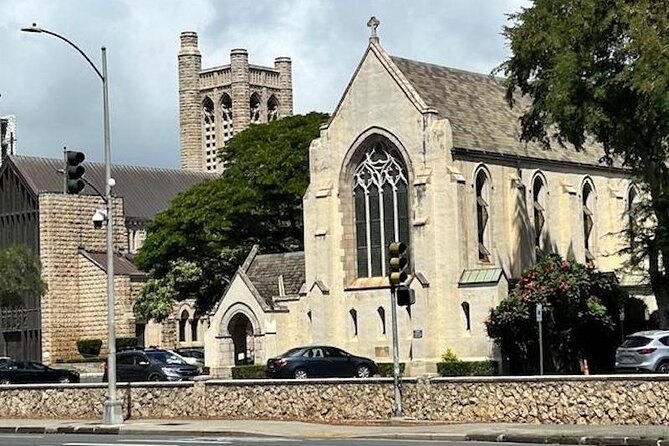
Stop 8: Cathedral of St. Andrew, England-cut sandstone and a tragic tale
The Cathedral of St. Andrew is built from thousands of block of sandstone cut in England and shipped to Hawaii. That alone gives you a sense of how global the story of Honolulu could be. Add the magnificent stained glass nave, and you get one of the most photogenic moments on the walk.
But the tour doesn’t stop at the wow factor. It also ties in a tragic tale of a king and his little boy. This stop works well for people who want architecture and story in the same package.
If you care about atmosphere, pause a beat and take in the nave. Then listen for how the guide connects the cathedral’s materials and symbolism to the wider narrative of power and loss.
Stop 9: Capitol Modern (Hawai’i State Art Museum), from the Royal Hawaiian Hotel to today
Now you reach Capitol Modern, also known as the Hawai’i State Art Museum. Here’s the twist: this site was the original Royal Hawaiian Hotel, built in 1872. That success led to a second Royal Hawaiian on Waikiki Beach, called the Pink Palace.
This stop is a reminder that Honolulu’s history isn’t only royal or courtroom drama. It’s also about hospitality, business success, and how places get reused. The architecture and the idea of the hotel become part of the story, not just a backdrop.
Admission here is listed as not included, so if you want to go inside, plan for that extra step. Even if you don’t, the guide’s explanation helps you see how a single location can represent different eras.
Stop 10: Ali’iolani Hale, the Judiciary Building and the Massie Affair
The final stop is Ali’iolani Hale, now home to the Hawaii State Supreme Court and serving as a Judiciary Building. This is where the Massie Affair played out, described as the marquee event of Hawaiian jurisprudence.
This is a key capstone. It shifts your focus from monarchy and religion into law—how conflict turns into cases, arguments, and outcomes. When the tour ends here, the strange and tragic theme stops feeling random. It becomes a chain: conquest to overthrow to institutions that try to define justice afterward.
With a short stop (about 5 minutes), the goal is clarity, not deep research. The guide gives you the framework so you can keep reading on your own after the walk.
Price and logistics: what $39 buys you in real terms
Let’s put the pricing in practical terms. The tour is $39 per person for about 1 hour 30 minutes. You’re paying for a guided narrative that connects multiple major landmarks into one storyline. You’re also getting most stops with free admission listed in the itinerary.
The two costs that can change your total are Iolani Palace and Capitol Modern, which are marked as not included. If you’re the kind of person who likes to go inside historic buildings, you’ll likely pay extra there anyway—so the $39 price still feels like the “guide + everything else” bargain.
You’ll also benefit from the pacing. With 10 stops and short time windows at each, it’s ideal if you want a structured overview rather than a long, wandering day.
Finally, the tour runs with a maximum of 20 people. That keeps it from turning into a noisy parade, which matters on a topic this heavy.
Pace, comfort, and the slightly spooky tone
This is a walking route through downtown Honolulu. It’s not described as a long hike, but it does involve standing at monuments and pausing for explanations. One practical detail: the guide helps by keeping you in the shade when possible, which can matter in direct sun.
On the content side, this is history with a dramatic edge. The tour’s theme is strange and tragic, and the narration includes ghostly lore. If you like that kind of storytelling, you’ll probably find it memorable. If you don’t, think of it as seasoning on top of the main historical storyline.
Who this tour fits best
I’d point you toward this walk if you:
- want Honolulu beyond beaches and resorts
- enjoy stories that connect places to political and legal change
- like architecture but also want the meaning behind it
- want a group tour that doesn’t feel huge or impersonal
You might skip it if your ideal history day means long museum hours with minimal walking, or if you strongly prefer sightseeing with no supernatural framing at all.
Should you book this Honolulu history tour?
If you’re in Honolulu for a few days and want one activity that gives context fast, this is a strong pick. The $39 price makes sense because you’re hitting a lineup of major sites, most of which are listed as free, while getting an explanation that ties them together. Start at Kamehameha, end at the courts, and you leave with a bigger picture than you’d get from quick, unconnected visits.
If you’re willing to plan for extra admission at Iolani Palace and Capitol Modern, this tour becomes even better value. It’s the kind of walk that helps you look at the city and understand what’s underneath the postcards.
FAQ
FAQ
How long is the Through A Glass Darkly Honolulu tour?
It’s about 1 hour 30 minutes.
Where does the tour start and end?
It starts at the King Kamehameha I Statue at 447 S King St, Honolulu, HI 96813, and it ends back at the meeting point.
How much does it cost?
The price is $39.00 per person.
Is the tour offered in English?
Yes, it’s offered in English.
Is a mobile ticket used?
Yes, the tour uses a mobile ticket.
Do I need to pay admission fees for the stops?
Most stops are listed as free, but admission is not included for Iolani Palace and Capitol Modern.
Can I cancel for free?
Yes. You can cancel up to 24 hours in advance for a full refund.